Cemented carbide, also known as metal hard compound alloy material, is an alloy material made of hard compounds of refractory metals and bonding metals through powder metallurgy. There are many types of cemented carbide, which are suitable for various cutting, wear resistance, impact resistance and other working conditions, so it is widely used in daily production. Next, the editor will take you to look at the introduction of different types of cemented carbide.
Common classification of cemented carbide
Cemented carbide, also known as metal hard compound alloy material, is an alloy material made of hard compounds of refractory metals and bonding metals through powder metallurgy. There are many types of cemented carbide, which are suitable for various cutting, wear resistance, impact resistance and other working conditions, so it is widely used in daily production. Next, the editor will take you to look at the introduction of different types of cemented carbide.
Cemented carbide has a series of excellent properties such as high hardness, wear resistance, good strength and toughness, heat resistance and corrosion resistance, especially its high hardness and wear resistance, which basically remain unchanged even at a temperature of 500°C, and still have a high hardness at 1000°C. There are three main types of cemented carbide for cutting tools, cemented carbide for geological mining tools and cemented carbide for wear-resistant parts.
1. Cemented carbide for cutting tools:
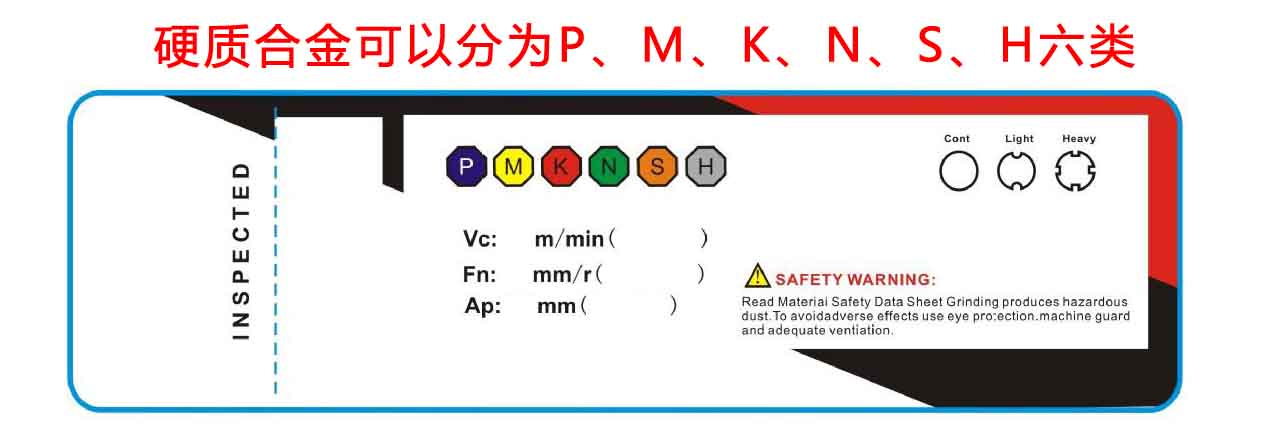
Cemented carbide for cutting tools is divided into six categories according to different fields of use: P, M, K, N, S, and H;
P category: Alloys/coated alloys based on TiC and WC and with Co (Ni+Mo, Ni+Co) as binder are often used for processing long-chip materials, such as steel, cast steel, long-cut forgeable cast iron, etc.; taking the grade P10 as an example, the processing conditions suitable for high cutting speed, medium and small chip cross-section conditions of turning, profiling, threading and milling;
M category: Alloys/coated alloys based on WC, with Co as binder and a small amount of TiC added, are often used for processing stainless steel, cast steel, manganese steel, forgeable cast iron, alloy steel, alloy cast iron, etc.; taking the grade M01 as an example, it is suitable for fine turning and fine boring under high cutting speed, small load and vibration-free conditions.
K-type: alloy/coating alloy based on WC, Co as binder, with a small amount of TaC, NbC added, commonly used in the processing of short-chip materials, such as cast iron, chilled cast iron, short-chip malleable cast iron, gray cast iron, etc.;
N-type: alloy/coating alloy based on WC, Co as binder, with a small amount of TaC, NbC or CrC added, commonly used in the processing of non-ferrous metals and non-metallic materials, such as aluminum, magnesium, plastic, wood, etc.;
S-type: alloy/coating alloy based on WC, Co as binder, with a small amount of TaC, NbC or TiC added, generally used in the processing of heat-resistant and high-quality alloy materials, such as heat-resistant steel, various alloy materials containing nickel, cobalt, and titanium;
Class H: Alloy/coated alloy based on WC, with Co as binder and a small amount of TaC, NbC or TiC added, commonly used for hard cutting processing, such as hardened steel, chilled cast iron and other materials;
II. Cemented carbide for geological and mining tools:
Cemented carbide for geological and mining tools is divided into the following categories according to the different parts of use:
A: Cemented carbide for rock drill bits; operating conditions, such as grade GA05, suitable for soft rock or medium hard rock with uniaxial compressive strength less than 60MPa, grade GA50/GA60 is suitable for hard rock or extremely hard rock with uniaxial compressive strength greater than 200MPa; as the grade number increases, wear resistance decreases and toughness increases.
B: Cemented carbide for geological exploration;
C: Cemented carbide for coal mining;
D: Cemented carbide for mine and oil field drill bits;
E: Cemented carbide for composite sheet substrate;
F: Cemented carbide for snow shovel;
W: Cemented carbide for digging teeth;
Z: Other categories;
The Rockwell hardness of alloys in this category can reach HRA85 and above, and the bending strength is generally above 1800MPa.
III. Cemented carbide for wear-resistant parts
Wear-resistant parts are divided into the following categories according to their use areas:
S: Cemented carbide for drawing of metal wires, rods, and tubes, such as drawing dies, sealing rings, etc.
T: Cemented carbide for stamping dies, such as dies for fastener stamping and steel ball stamping.
Q: Cemented carbide for high-temperature and high-pressure components, such as top hammers and pressure cylinders for synthetic diamonds.
V: Hard alloy for wire rolling roller rings, such as roller rings for high-speed wire rolling finishing mills, etc.


